Experienced Game Designer with a 7+ year record of success in driving system, content, economy, and activity design for increased player engagement and revenue generation.
Blizzard Unannounced Survival Project
.jpg)
Project Odyssey was Blizzard's take on the survival genre — an AAA, mass-market title built in UE4. I joined as a System Designer, owning the resource economy, crafting systems, tech tree progression, and resource distribution across the open world. The project was cancelled in April 2024.
The Challenge
Survival games live or die by their resource economy. My core design problem: players need to spend resources constantly — building bases, crafting gear, restocking consumables — while simultaneously earning them through gathering, combat, and PvP looting. If either side breaks down, the game collapses into a grind or inflates into meaninglessness.
Two additional constraints made this harder than it sounds:
Readability first. Early-game resource distribution had to be intuitive enough that new players could navigate it without a tutorial wall — spawn logic had to communicate the rules spatially.
Coordinated intent. Resource placement wasn't mine alone to decide. Spawn patterns needed to funnel players toward specific zones in alignment with the World and Procgen teams' broader map design — the economy couldn't be designed in isolation.
Design Philosophy: Legible Worlds
Most survival games treat resource distribution as a random scatter problem. In playtesting and studying other titles in the genre, I noticed a consistent failure: players couldn't build a mental model of where to go because spawn logic felt arbitrary. You found iron because you wandered long enough, not because you understood the world.
I set out to design against this with two principles:
1. Resources must exist where they logically belong. 2. Finding a resource requires an obvious intermediate target, not a search.
The mushroom is the clearest example. Mushrooms spawn on rotting wood — ecologically coherent and immediately readable. Rotting wood appears near tree roots, which are found in forest zones. So the search chain becomes: I need mushrooms → I find rotting wood → I look near trees → I go to the forest. Each step has a large, visible target. A new player doesn't need to memorize spawn tables; they just need to understand the world as a place.
This principle extended to how I collaborated with the Procgen and World teams on resource distribution rules in UE4. Spawn logic wasn't just about yield numbers — it was about ensuring that the landscape itself communicated where resources lived. The economy only works if players can actually find the resources they need to participate in it.
The Key Insight: Three Players, One Economy
Playtesting quickly revealed that "the player" doesn't exist. Three distinct archetypes behave fundamentally differently:
A single resource curve cannot serve all three without breaking for at least one group. My approach: design around solo pacing as the floor, and treat group efficiency and PvP looting as accelerators — ways to reach the same milestones faster, rather than pathways to a structurally different economy.
The critical design question then became: how do you prevent these accelerators from outpacing the system?
Keeping Accelerators in Check
Rather than imposing hard caps, I designed each accelerator to carry its own counter-pressure:
PvP looting is self-regulating. High-value targets mean high-risk engagements — death penalties and gear degradation mean aggressive players are constantly spending back into the economy. The player who loots the most also loses the most when they overextend. Competitive pressure in high-value resource zones creates natural throttling without any designer-imposed limits.
Group play has proportionally higher expenditure demands. Group players gather faster, but they're also building and maintaining a shared village — base construction is a resource sink that scales with team size. The acceleration doesn't accumulate; it gets absorbed by collective spending requirements. Groups reach milestones faster not because they're richer, but because they can sustain a higher throughput against a higher cost structure.
Validating the Pacing
For the tech tree, I established target unlock times per tier and validated them against playtest data using a combination of signals: time-to-unlock distributions, per-archetype gather rates, and observed player behavior at each progression gate.
When real numbers diverged from targets, I traced the gap back to its specific source — spawn density, recipe cost, or a tier's geographic position — and adjusted at that level rather than broad-tuning the whole economy.
Outcome
The tech tree pacing received positive feedback in internal playtests, with evaluators noting that progression felt purposeful without artificial bottlenecks. The three-archetype model held up across test cycles, with each player type progressing at a pace consistent with their playstyle while remaining within the intended economy envelope. Playtest data analysis produced a prioritized optimization list that fed directly into the next iteration cycle.

Perfect World International II
Genre: MMORPG
Platform: PC
My Title: Senior Game Designer
My Responsibility:
-
Led a 5-person team to produce systems, activities, and dungeon instances in each expansion pack to ensure players remain engaged and do not churn.
-
Designed an equipment simulator adopted by over 85% of active players, helping players optimize gear builds and progression.
-
Designed and implemented a new weekly boating event with humorous voting mechanics and a live comment system that increased participation by 3×.
-
Designed and implemented new dungeon instances, including encounter design, mission design, and narrative design.
-
Owned the faction system, the faction base, and the faction pet system, attracting 150K players.
-
Designed a mentorship system, and designed a dungeon instance for the mentorship system, attracting 200K players.
Starward Game Studios Projects
Platform: Mobile
My Title: Lead Game Designer
My Responsibility:
-
Led the design of gameplay systems including AI-driven social deduction mechanics, ranking systems, progression loops, and monetization structures across multiple prototype projects.
-
Built rapid gameplay prototypes using Godot (GDScript) and Unity, implementing systems such as Metroidvania-style character movement and combat, match-3 mechanics, and interactive UX flows.
-
Designed LLM-powered AI characters with distinct personalities, enabling dynamic dialogue, player deception, and emergent social gameplay.
Zing Games Studio - Unannounced pinball game & Side Sandbox projects
My Title: Game Designer
My Responsibility:
-
Implemented various gameplay features in Unity (C#), including character control, UI/UX, and mission logic.
-
Designed roguelike progression elements including skills and trinkets, along with level layouts, puzzles, quest flows, and cinematic scenes to enhance immersion and gameplay variety.
-
Applied 3D math in character movement, and level mechanics to create responsive gameplay. Used Maya to create level blockouts.
Dear Future
Tech: Unity, Perforce, Wwise, Jira
Team of 6, 09/2020 - 03/2021
-
About the game:
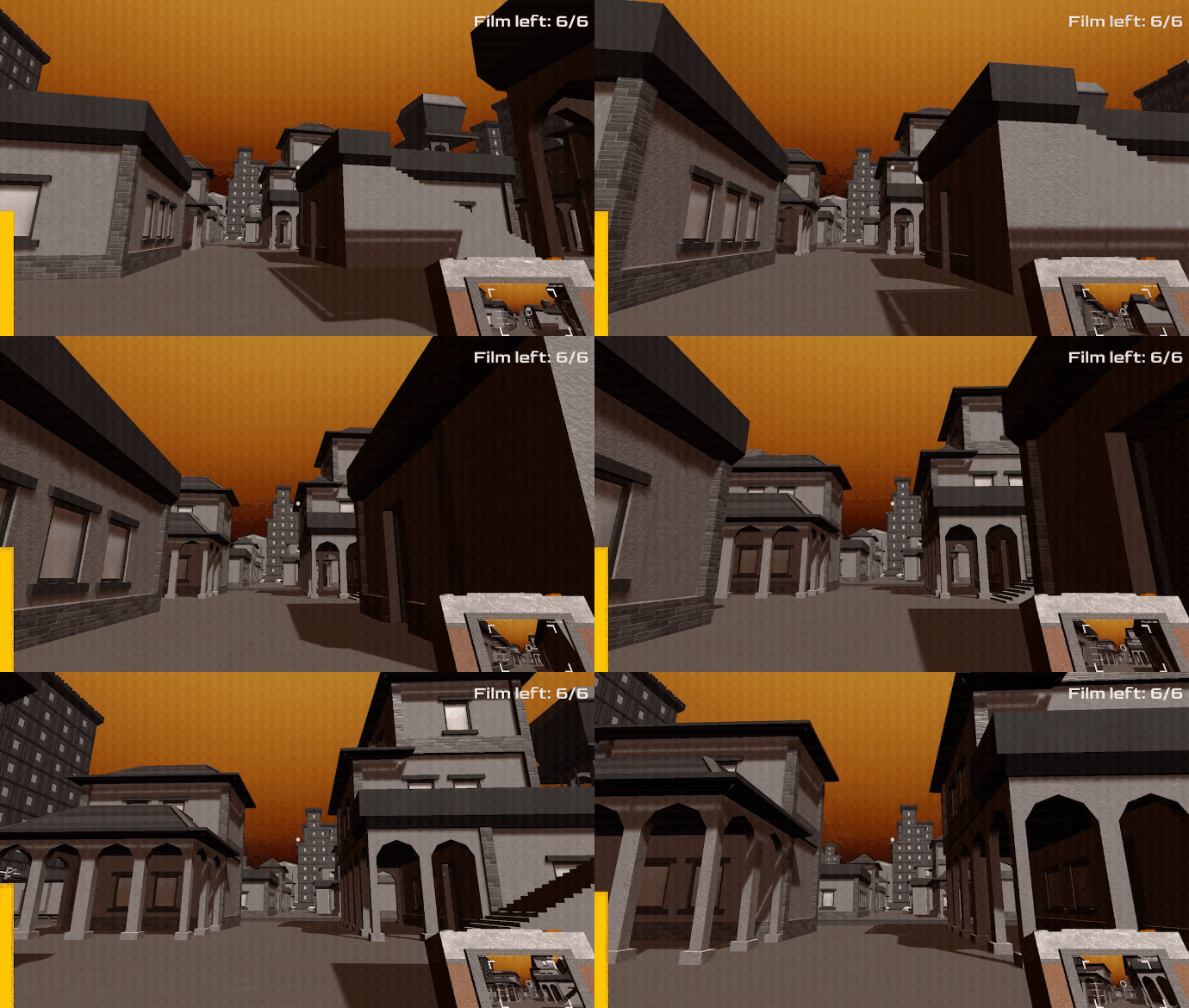
Dear Future is a co-operative photography game.
Where players collectively document a post-human city using an inherited camera.
Uncovering hidden truths as they wander its depths together.
-
My role and work I did:
Lead Designer, Programmer
-
Design the game-play mechanic such as using the camera to recover objects.
-
Narrative design, design how players find the truth of the city.
-
Level design to let players have a better experience when they wandering in the city.
-
Programming the respawn mechanic and stamina increase mechanic.

Rope?!
Tech: Unity, GitHub, FMOD
Team of 5 in 3 weeks, 05/2020
-
About the game:
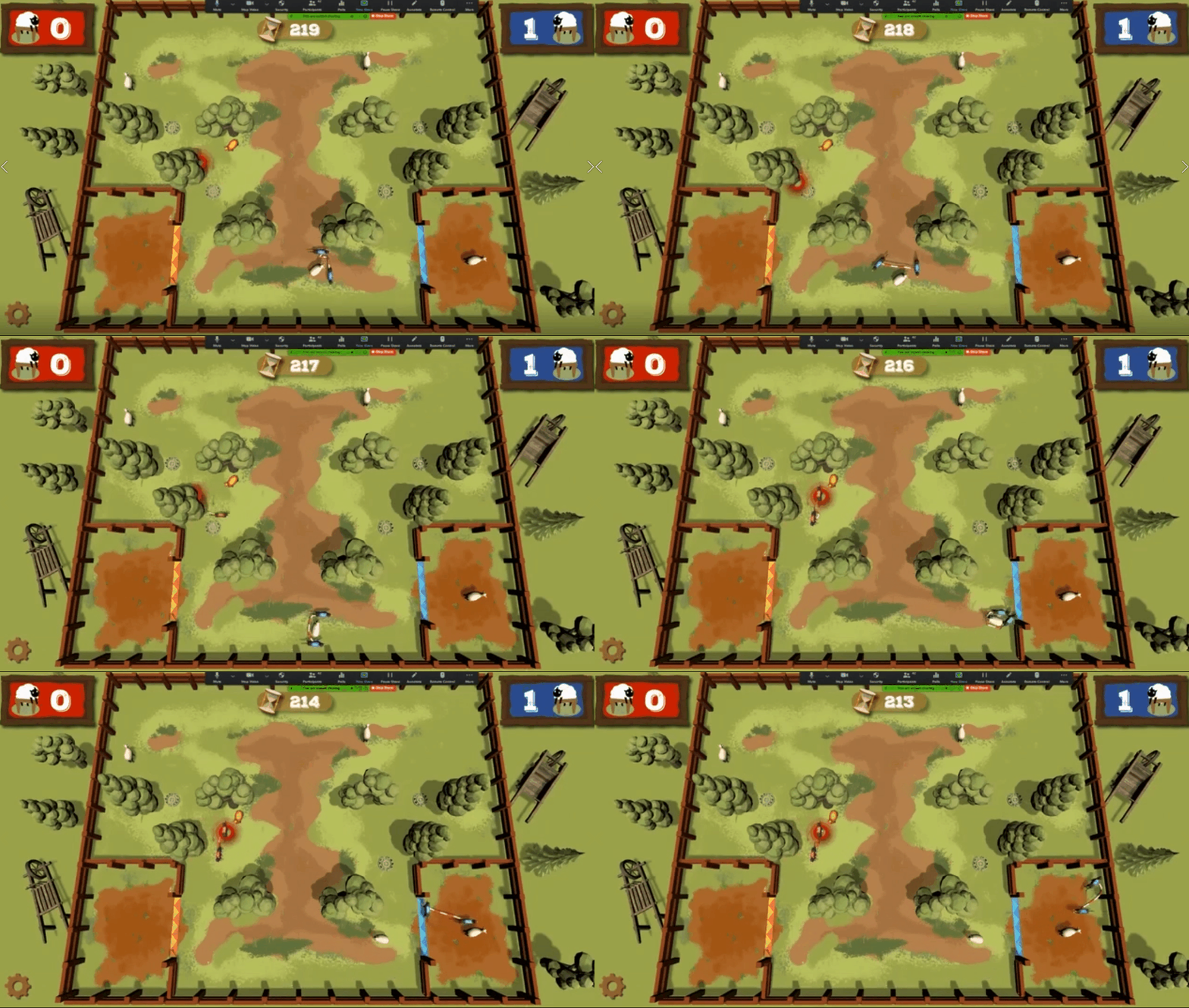
Rope?! is a networked 2 vs 2 PVP game.
Players control a shepherd that is connected with their teammate with a rope. Players should try to use the rope to herd the sheep into their sheepfold to gain scores. The team who gets the higher score will be the winner.
-
My role and work I did:
Lead Designer
-
Design the game-play mechanic and rules.
-
Design the arena of the game
-
Audio design and implement of the game